Moses of Michelangelo, drawing (1913-4)

This drawing by Freud is a rendering of Michelangelo’s Moses. In his private letters, Freud describes numerous profound encounters with the biblical figure of Moses in front of the sculpture, part of the base of the unfinished funerary for Pope Julius II at San Pietro in Vincoli, Rome. He would later use the sculpture as the title for his famous essay “The Moses of Michelangelo” (1914). Freud theorized that Michelangelo had rendered the figure of Moses as holding the tablets of the ten commandments upside down, an act which suggested a narrative of paternity, castration, and the law. His interest in Michelangelo, and in art more generally (including works by, among others, Leonardo, Goethe, Wilhelm Jensen, and E.T.A. Hoffmann), forms part of the larger foray of psychoanalysis into art and culture, where Freud utilized psychoanalytic insights to articulate larger claims about society and politics.
Keep scrolling to explore this image in more detail.
Figure 1
The drawing shows Moses in near profile.
He gazes downwards in wrath as he holds his beard and the tablets of the Ten Commandments.
Freud’s drawing emphasizes how Moses’ psychic state urges him to act or react.

Figure 2
He is depicted as about to stand up, rather than solemnly sitting.

Figure 3
The drawing differs significantly from Michelangelo’s statue, especially with respect to the position of the tablets and the way they relate to Moses’ right hand, fingers and beard.

Figure 4
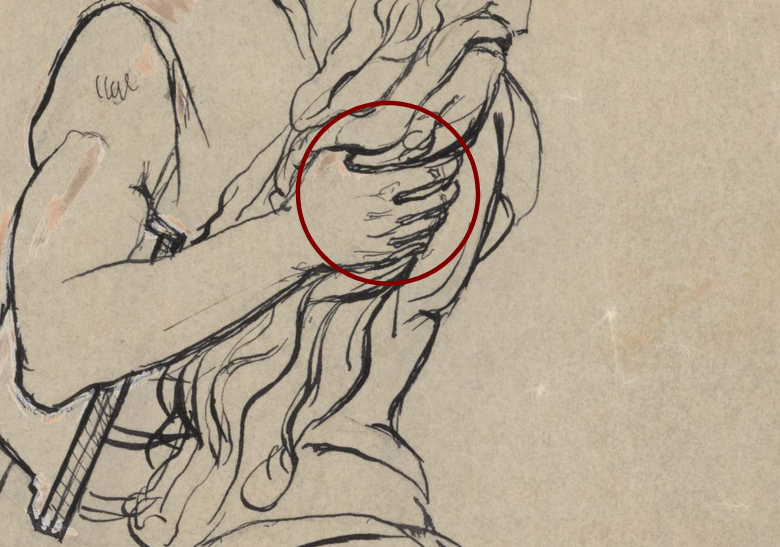
On the left side of the drawing, there are multiple corrections made, potentially by Freud, around the drapery covering Moses’ shoulder, his biceps and the tablets—all areas that were thoroughly dissected in Freud’s essay, and that he deemed essential to understanding Moses’ state of mind.
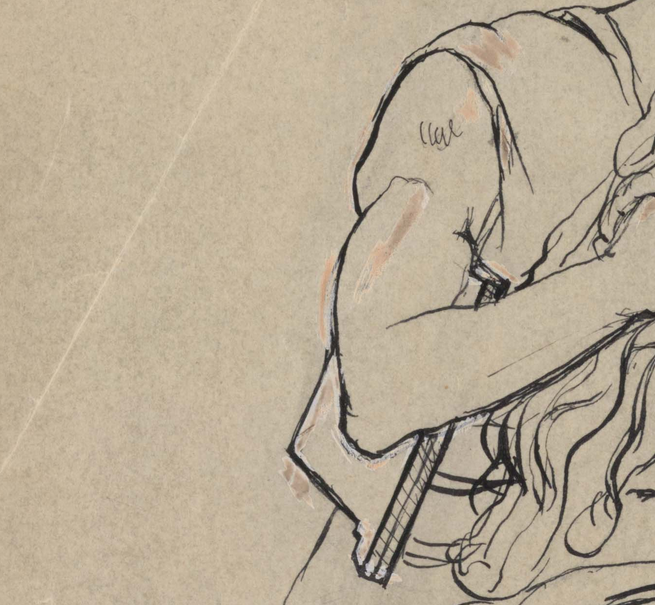
Figure 5
Additional corrections were made by Freud to the image of Moses’ right thumb and the way that his hand grasps his beard. These corrections and multiple deviations from Michelangelo’s sculptures have sparked much debate among psychoanalysts and art historians concerning the role of psychoanalysis in decoding Michelangelo’s unfinished funerary and, moreover, the importance of gesture as a category of art-historical study.