

.
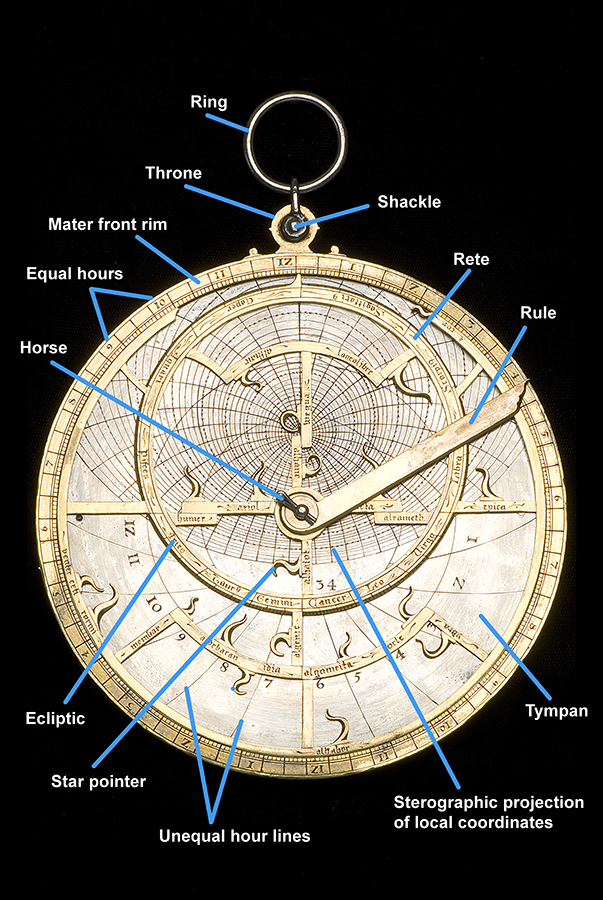
Parts of the Astrolabe:
The Front
Ring: Used to suspend the astrolabe, typically from the thumb. Shackle: Connects the ring to the throne which is the top of the astrolabe body.
Mater: The astrolabe body, so-named from the Latin word for “mother” because it holds all the tympans (plates) within itself. The raised rim of the mater is divided into degrees and 24 equal hours (like that used in our modern timekeeping system).
Tympan: An inner plate engraved with one or more projections of the sky for particular latitudes and quadrants of unequal hours. Stereographic projection of local coordinates: Arcs of altitude and azimuth for a particular latitude engraved on the tympan. They form a grid on which to locate stars. Unequal hour lines: Used to find the time using a system of seasonal, unequal hours that divide every day and night into twelve hours.
Rete: Named from the Latin word for “net,” this pierced disk is a map of the sky. It is a stereographic projection of the great celestial circles and stars onto the plane of the Celestial Equator as seen by one looking up at it from the South Pole. The tip of a star pointer indicates the position of a bright star on the map. The offset circle is the ecliptic, the path of the Sun and planets through the 12 signs of the Zodiac. (See the next figure for the rete removed from the astrolabe.
Rule: An index for lining up points on the ecliptic and outer scales on the mater in order to read the astrolabe.
Inv Number: DW0594
Date: second half of 16th century?
Maker: French
Back to "Time, Life, & Matter: Colonial Science".