

Freud’s Consulting Room

This is a rendering of Freud’s consulting room, with a glimpse through a doorway into his bookshelf-lined private study, at his home, Berggasse 19, Vienna. The consulting room has been arranged with the comfort of Freud’s patients in mind. Anchoring this illustration, we see his famous couch, covered with a colorful oriental carpet and piled high with pillows. A “typical Viennese ceramic tile stove” warms the room. Blankets, for use by patients, sit at the foot of the couch. Sitting on his chair in the corner, behind the patient’s head, Freud could survey the pictures, photographs, and mementoes that grace the room’s walls, as well as the hundreds of antiquities displayed on every available surface. The overall effect on visitors was overwhelming; the whole, wrote a psychoanalyst later, is “an embarrassment of riches.” The presence of so many figures from the past served as an invitation to patients “to rediscover [their] own origins and buried history.”
Keep scrolling to explore this image in more detail.
Figure 1
This bas-relief of Gradiva fascinated Freud, who developed Gradiva, the “lady who paces away,” into a paradigm for analysis. More about her significance is presented in the final section.
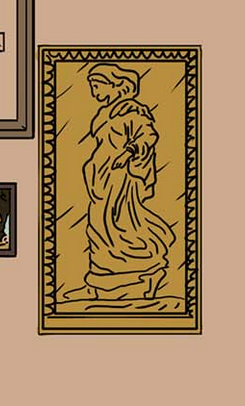
Figure 2
This painting of Oedipus and the Sphinx, copied after Jean August Dominique Ingres (1808), testifies to Freud’s continuing engagement with the Greek tragedy Oedipus Rex. The Oedipus complex—named for the protagonist who kills his father and marries his mother—was at the very center of Freud’s theory.
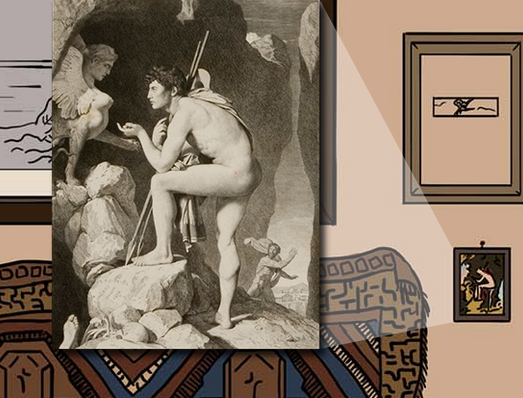
Figure 3
The couch is perhaps the most iconic and universal of psychoanalytic objects. Patients recumbent on the couch could not see Freud, seated in the chair behind their heads—meant to insure they would not be distracted by looking at him, thus allowing the freest possible movement of unconscious material to consciousness.
Freud sat in the chair to the left of the couch while patients spoke, out of their line of sight.

Figure 4
This image shows the Egyptian cliff temple of Ramesses II at Abu Simbel. Considered the greatest of the pharaohs, Ramesses II was a figure with whose strength and power Freud possibly identified.
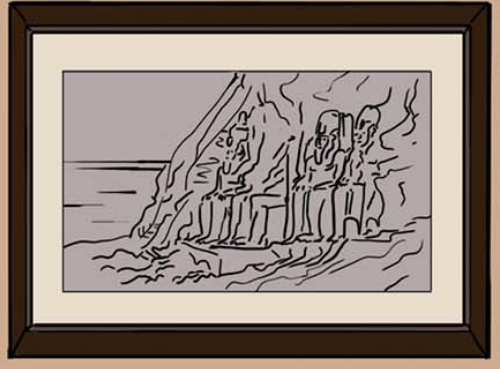
Figure 5
The falcon-headed Egyptian god Horus was part of Freud’s voluminous collection of antiquities. The son of Isis and Osiris, Horus had intrigued Freud since childhood, when he encountered him in the family’s lavishly illustrated Phillipson Bible.
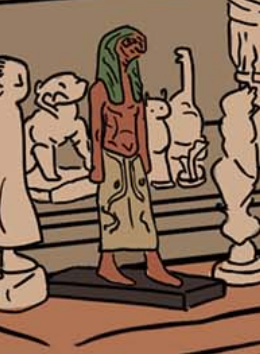
Figure 6
The black ceramic tiled stove regulated the room’s temperature, with two water tubes that maintained a constant level of humidity.
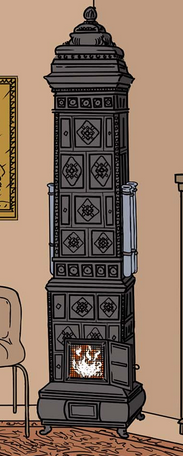
Figure 7
The oriental rugs on the floor and atop the small table on the left side of the room, as well as on the couch and wall behind it, are the only patterned elements in the room. Fin de siècle Viennese were entranced by arabesque patterns, believing in their psychosomatic effects.
